
Why Representation in Comics Matters: Black Heroes, Black Creators, and Bold Readers
- Antonio Brown
- Jan 16
- 5 min read
POW! A young reader flips the page and freezes. Eyes wide. Heart racing.
There, in full color, cape billowing, fist raised, ready to save the universe, is a hero who looks just like them.
Natural hair? Check. Brown skin glowing under city lights? Absolutely. A story that feels like it was written for their world? BOOM. That's the magic we're talking about.
Welcome to the revolution, fam. Comics aren't just entertainment anymore, they're mirrors, windows, and rocket ships to possibility. And for Black youth across Pinellas County, Florida, and beyond? Representation in those glossy pages isn't just nice, it's necessary.
Let's dive into why Black heroes and Black creators are changing the game, and how YOU can bring that power home to your young reader.
🦸🏾 THE POWER OF SEEING YOURSELF IN THE STORY
Picture this: A kid walks into their local library or community center. They pick up a comic book and see a superhero with locs, or a scientist with an afro, or a young adventurer navigating a world that mirrors their own neighborhood. What happens next is nothing short of transformative.
Representation provides psychological and emotional validation. When young Black readers see themselves reflected in characters, not as sidekicks, not as stereotypes, but as the hero, something clicks. Research shows that this kind of visibility creates a healing capacity, building an emotional foundation that helps kids cope with real-world challenges and setbacks.
For too long, the comic book industry failed Black readers. During the Golden and Silver Ages of comics, characters were overwhelmingly white, male, and one-dimensional. When Black characters appeared? Often relegated to the background or squeezed into harmful tropes. The message was clear: These stories aren't for you.
But here's the twist in our origin story: That era is OVER.
Today's comics feature hijabs, natural hair, dark skin, diverse accents, and scenes reflecting the lived experiences of Black and Brown communities. Characters like Miles Morales (the Afro-Latino Spider-Man), Nubia, Shuri, and the legendary Storm aren't tokens, they're complex, fully realized heroes with rich backstories that resonate deeply with readers who've been waiting to see themselves in these pages.
And when a young Black boy in St. Petersburg or Clearwater picks up that comic and sees himself saving the world? That's not just reading. That's identity formation. That's confidence under construction. That's a future leader in the making.
🎨 BLACK CREATORS: THE ARCHITECTS OF A NEW ERA
Here's where it gets even more exciting. It's not just about who's on the page, it's about who's creating the page.
For decades, the comic industry was dominated by white male creators, which meant Black stories were often filtered through a lens that didn't understand them. But trailblazers like Dwayne McDuffie, the visionary behind Milestone Media and beloved characters like Static Shock, proved that diverse stories weren't just viable; they were phenomenal.
Fast forward to now, and we're witnessing a renaissance. Ta-Nehisi Coates penned an acclaimed Black Panther run that redefined what superhero storytelling could be. Artists and writers like Sanford Greene, Eve Ewing, Nnedi Okofor, and John Jennings are crafting universes where Black excellence isn't the exception, it's the rule.
Why does this matter? Because creators from different backgrounds bring authentic perspectives and cultural insights that result in more nuanced, vibrant storytelling. They understand the rhythm of Black joy, the complexity of Black struggle, and the beauty of Black community in ways that simply can't be replicated.
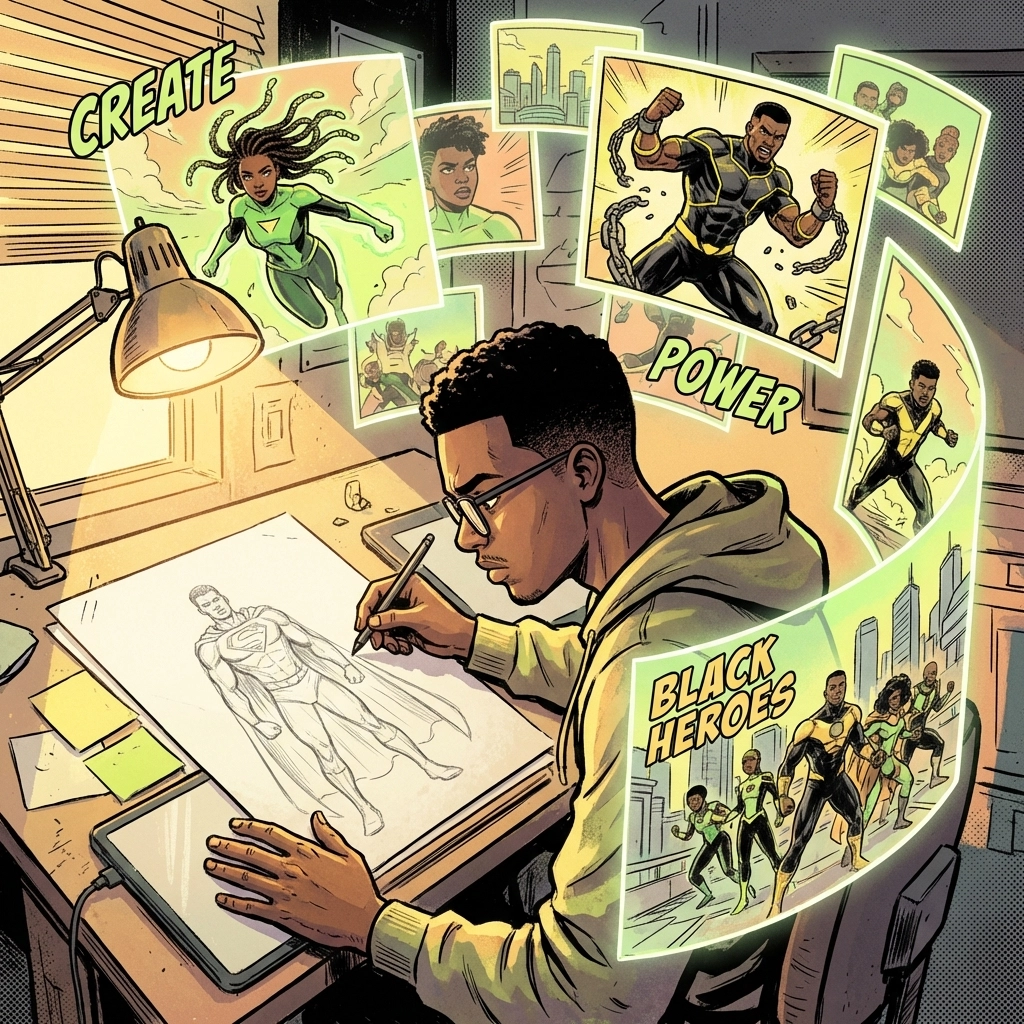
When Black creators hold the pen (or the digital stylus), the stories hit different. And young readers can feel it. They recognize authenticity. They connect with narratives that honor their experiences rather than caricature them.
This is representation on BOTH sides of the page, and it's revolutionary.
📚 COMICS AS A LITERACY SUPERPOWER
Now, let's talk about something that might surprise you: Comics are secretly one of the most powerful literacy tools out there.
For kids who struggle with traditional chapter books, especially young Black boys who are often underserved by conventional reading programs, graphic novels and comics offer a dynamic entry point. The combination of visuals and text creates multiple pathways for comprehension. Kids learn to:
Decode visual storytelling
Follow narrative sequence
Build vocabulary through context
Develop critical thinking by analyzing character motivations
And here's the kicker: When the content is culturally responsive? Engagement skyrockets.
Culturally responsive books for kids aren't just about checking a diversity box. They're about meeting young readers where they are, honoring their culture, their community, their identity. For Black boys in Florida searching for books that speak to their experience, comics featuring heroes who look like them can be the spark that transforms a reluctant reader into a voracious one.
At The Competitive Readers Coalition (CRC), we've seen this transformation firsthand. Our youth reading programs across Florida, including initiatives right here in Pinellas County, prioritize engaging, culturally responsive materials that capture young imaginations. Because when reading feels relevant, it becomes irresistible.
🗺️ PARENT PLAYBOOK: FINDING COMICS THAT REPRESENT
Alright, parents and caregivers: here's your action plan. You want to bring the power of representation home, but where do you start? Don't worry, we've got you covered.
1. Know Your Heroes
Start with these incredible titles featuring Black characters and creators:
Miles Morales: Spider-Man series
Moon Girl and Devil Dinosaur
Static Shock (classic and new editions)
Black Panther (multiple runs available)
Nubia: Real One by L.L. McKinney
Shuri by Nnedi Okofor
2. Explore Indie Publishers
Don't sleep on independent publishers! Companies like Oni Press, BOOM! Studios, and First Second consistently release diverse, youth-friendly graphic novels that center BIPOC experiences.
3. Visit Your Local Library
Libraries in Pinellas County have expanded their graphic novel collections significantly. Ask a librarian for recommendations: they love helping young readers find their next favorite!
4. Make It a Family Affair
Read comics together. Take turns voicing different characters. Discuss the storylines. Ask your child what they notice about the heroes: what makes them brave, smart, or relatable? Creating engaging family reading spaces around comics builds bonds AND builds readers.
5. Connect with CRC Programs
Looking for Pinellas County reading programs or youth reading programs in Florida that prioritize culturally responsive content? Check out CRC's online programs and community events designed to empower young readers: especially boys: through books that reflect their world.
💥 THE CRC MISSION: BOLD READERS, BRIGHT FUTURES
At The Competitive Readers Coalition, we believe every child deserves to see themselves as the hero of their own story. Our work across Pinellas County and throughout Florida focuses on creating engaging family reading spaces, supporting literacy in barbershops and community centers, and ensuring that books for Black boys in Florida aren't an afterthought: they're a priority.
We've witnessed the remarkable impact of representation. When young readers encounter culturally responsive books for kids, their confidence grows. Their curiosity expands. Their futures brighten.
Comics are just one piece of the puzzle, but they're a vibrant, exciting piece that captures imaginations and builds lifelong readers.
🚀 YOUR ORIGIN STORY STARTS NOW
Every superhero has an origin story. For some kids, that story begins the moment they crack open a comic and see a hero who shares their skin, their hair, their dreams.
Representation in comics isn't a trend: it's a movement. Black heroes inspire. Black creators innovate. And bold readers? They're the next generation of leaders, thinkers, dreamers, and change-makers.
So grab a graphic novel. Visit your local library. Connect with CRC and explore our programs designed to ignite the love of reading in every young person we serve.
Because when a child sees themselves in the story? That's when the real adventure begins.
KA-POW. 💥
Comments