


How to Build Your Son's Vocabulary in 5 Minutes: The Power of Daily Word Practice
- Antonio Brown
- Feb 4
- 6 min read
Five minutes. That's all it takes to unlock a word, plant a seed, and watch your son's vocabulary grow into something powerful. Not a tutoring session. Not flashcards stacked a mile high. Just five intentional minutes that transform the way he thinks, speaks, and navigates the world.
At The Competitive Readers Coalition, we've seen it happen hundreds of times: young men who couldn't articulate their ideas suddenly commanding rooms with confidence. Boys who struggled to express frustration now using precise language to advocate for themselves. It doesn't happen overnight, but it starts with one word, practiced daily, until it becomes part of who they are.
The secret isn't complexity. It's consistency. And today, we're breaking down exactly how to make those five minutes count.
Why Daily Practice Beats Marathon Study Sessions
Here's what research shows: consistent daily exposure to new vocabulary yields better retention than cramming once a week. Your son's brain needs repetition and real-world application to move a word from short-term recognition to long-term mastery. When vocabulary practice becomes a daily ritual: like brushing teeth or tying shoes: it stops being "school work" and starts being life.
Studies indicate that children who engage in brief, daily vocabulary exercises show up to 30% better word retention compared to those who practice irregularly. That's not just academic: it's transformational. A strong vocabulary directly correlates with reading comprehension, critical thinking, and even confidence in social settings.
Think about it: when your son can name what he's feeling (frustrated vs. disappointed vs. overwhelmed), he's better equipped to process emotions. When he can describe what he wants (collaborate instead of "work together," or advocate instead of "speak up"), he's training himself to think with precision. Vocabulary isn't just words: it's power.
Introducing: Word of the Day
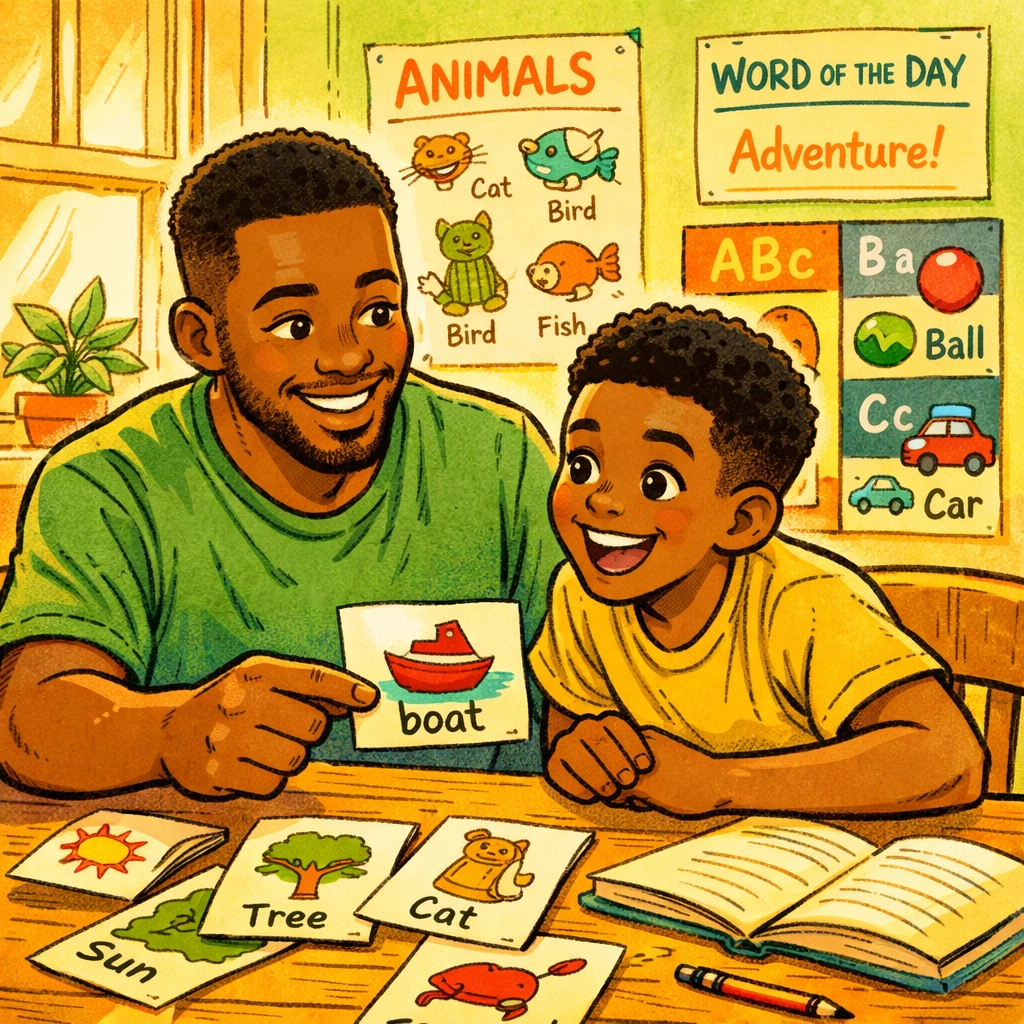
This is where the magic happens. Every day, introduce one new word. Not five. Not ten. Just one carefully chosen word that stretches his thinking and connects to his world. At CRC, we call this the Word of the Day approach, and it's the backbone of our literacy work in barbershops and community spaces across St. Petersburg.
Here's how it works in five minutes or less:
1. Introduce the word and its meaning (1 minute) Say the word out loud together. Break it down syllable by syllable. Explain what it means in everyday language: no jargon, no textbook definitions.
2. Share where it comes from (1 minute) Etymology makes words stick. When your son learns that erudition comes from the Latin erudire, meaning "to free from roughness" or "to educate," he understands that knowledge is about refinement and growth: not just memorization.
3. Use it in a sentence that matters (1 minute) Don't just say, "The professor's erudition was impressive." Make it personal: "Your erudition: your deep knowledge and love of learning: is what's going to open doors no one thought you could walk through."
4. Challenge him to use it today (2 minutes) Ask your son to think of his own example. Where could he use this word today? In a conversation with a teacher? A text to a friend? A journal entry? The goal is active usage, not passive listening.
This Week's Word: Erudition
Let's start strong.
Word: Erudition Pronunciation: eh-roo-DISH-un Definition: Profound knowledge acquired through reading, study, and learning; scholarly wisdom.
Origin: From Latin erudire (to instruct, educate), literally "to free from roughness": the idea that education polishes and refines the mind.
In Action: "The young men who come through CRC's programs aren't just learning to read: they're building erudition. They're becoming scholars in their own right, thinkers who can hold conversations with confidence and clarity."

When you introduce a word like erudition, you're not just expanding vocabulary: you're reshaping identity. You're telling your son: You are a scholar. You are someone who seeks knowledge. You belong in spaces where big ideas are discussed.
Five More Strategies for Five-Minute Wins
The Word of the Day is your foundation, but here are five other quick tactics you can rotate throughout the week:
1. Vocabulary in the Wild
During everyday activities: cooking, driving, walking: describe what you're doing using elevated language. Instead of "mix the ingredients," say "combine" or "incorporate." Instead of "it's raining hard," say "it's torrential." Your son absorbs vocabulary through exposure, and when he hears you using strong words naturally, he'll start to mirror that language.
2. The Four-Step Deep Dive
Once or twice a week, take a word deeper:
Explain it in your own words
Give two examples from real life
Ask your son to create his own example or name the opposite
Use it in conversation over the next 48 hours
This method cements retention because it moves from passive understanding to active creation.
3. Word Games on the Go
Play "I Spy" with descriptive language. Instead of "I spy something red," try "I spy something crimson" or "I spy something vibrant." Play "20 Questions" where the goal is to use precise adjectives. These games take zero prep and can happen anywhere: in the car, at the park, waiting for a haircut.
4. Flashcard Races
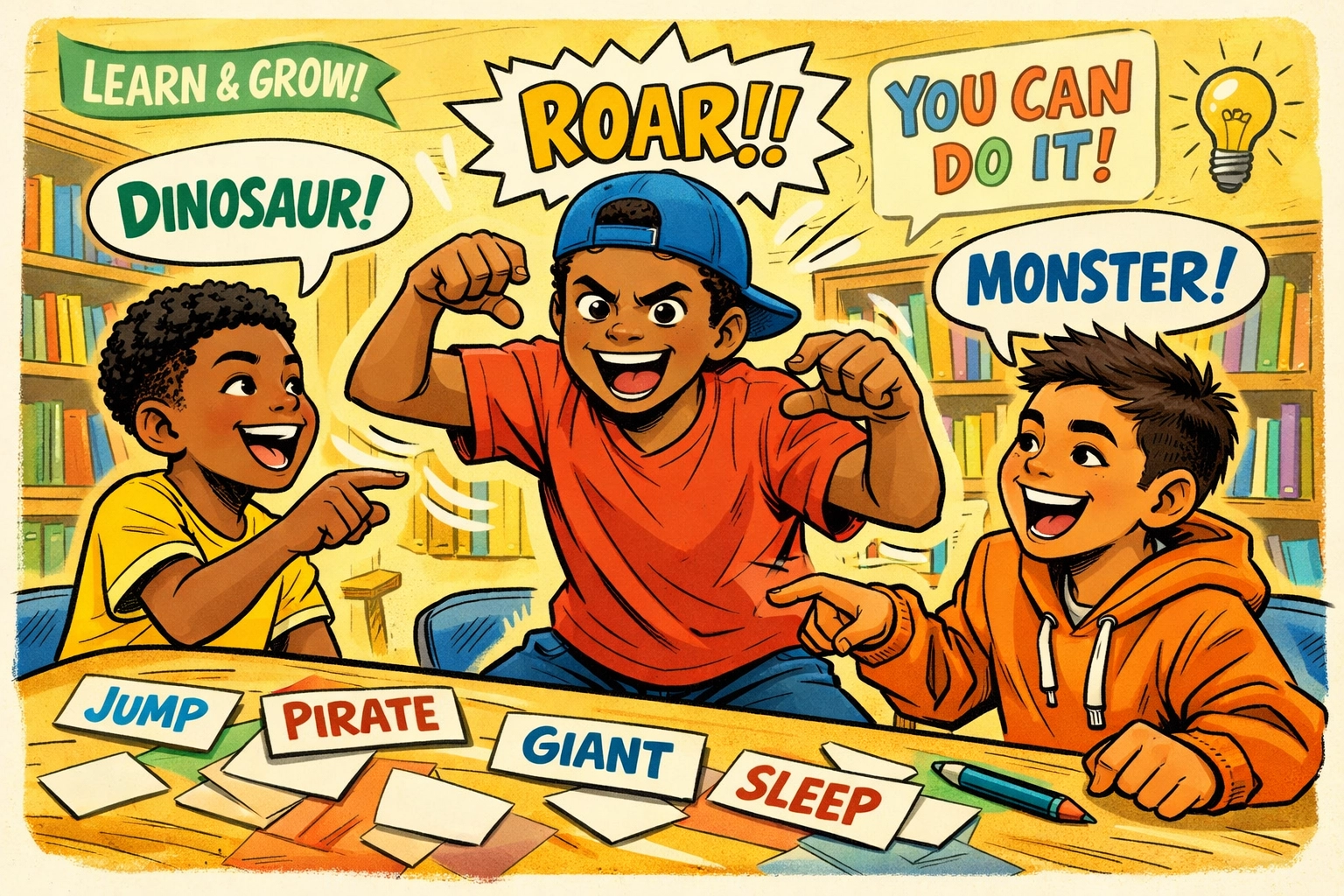
Write words on index cards and definitions on separate cards. Spread them out and call out a definition: your son races to match it to the correct word. It's fast, it's fun, and it builds instant recall. You can make it competitive (time him) or collaborative (work together to beat the clock).
5. Vocabulary Charades
Write action words or descriptive words on slips of paper. Your son draws one and acts it out without speaking. After you guess, discuss the word's meaning together. This works especially well for abstract concepts: words like resilience, determination, or collaboration become tangible through movement.
Why This Matters for Black and Brown Boys
Let's be honest: the education system hasn't always made space for our boys to see themselves as intellectuals, as scholars, as erudite young men. Too often, they're tracked into remedial classes, suspended for behaviors that get excused in their white peers, or told they're "not college material."
But when you build vocabulary at home: when you create a daily practice that says, Your voice matters, your thoughts are valuable, and you deserve to articulate them with power: you're doing more than teaching words. You're disrupting a narrative. You're equipping your son with the linguistic tools to advocate for himself, to challenge injustice, and to walk into any room knowing he belongs.
That's why CRC embeds Word of the Day practices into all eight of our programs: from FROM THE BARBERSHOP TO THE BOARDROOM to our Youth Workforce Development and Training initiative. We know that literacy isn't just about reading books. It's about building identity, confidence, and access.
Making It Stick: The CRC Framework
At The Competitive Readers Coalition, we don't just drop vocabulary on young men and hope it sticks. We integrate it into trusted community spaces: barbershops, rec centers, homes: where boys already feel safe. We pair words with identity-affirming programming that says: You are brilliant. You are capable. You are necessary.
Our Financial Literacy and Homeownership Program (in partnership with LMCU) teaches young men words like equity, asset, and investment: not in a classroom, but in barbershops where conversations about generational wealth feel natural. Our Youth Workforce Development and Training program introduces professionalism, networking, and reciprocity as boys transition from the shop to the boardroom.
Vocabulary isn't separate from life: it's woven into every experience, every program, every conversation. And that's exactly how it should be in your home, too.
Your Five-Minute Challenge
This week, commit to five minutes a day. Pick one word from the list we're featuring this month: start with erudition: and build it into your routine. Say it at breakfast. Use it in a text. Ask your son to spot it in a book or a song.
Watch what happens when language becomes a daily practice instead of a one-time lesson. Watch your son start to own words, to wield them with confidence, to become the scholar you always knew he could be.
Because that's what we're building here: not just readers, but thinkers. Not just students, but leaders. Not just boys, but young men equipped with the erudition to change the world.
Ready to build vocabulary and brilliance together? Explore CRC's programs and join a community committed to empowering young men through literacy, identity, and opportunity. Learn more at crcbooks.org.
Connect with us on LinkedIn:www.linkedin.com/in/the-competitive-readers-coalition-169ba43a7
Comments